Back in January 2025 my very good friend Joseph was coming to Luxembourg to record the complete works of French composer Alkan. While deeply interested in organ music since about the age of 5 I had never heard of this composer.
Perhaps because the most exciting pieces are off the scale of difficulty, they are ignored by most performers. Perhaps as many were originally written for pedal piano their migration to the organ world was not really thought to be valid. What ever the circumstances, the revival of this man’s music is one of the most wonderful musical events as organists we are ever likely to experience. Our video is at the bottom of this blog but if you want a shortcut to avoid my verbage follow this link.
A plan to record the works of Alkan
In 2019 Joseph told me of the plan to record the works and he began the massive task to prepare for it. He had hoped to record at La Madelaine in Paris as Alkan had played that instrument and would have known its soundscape when writing many of his actual organ works. Sadly, the covid pandemic added several years of delay to the project and by the time covid problems had recessed La Madelaine’s organ was undergoing refurbishment and later so was the building. A search for a new venue had to begin.
A critical factor in choice of instrument was the need for a large colourful sonic landscape and a good combination system of general pistons or stepper. The need for rapid registration changes was essential. This was not a burden Joseph, or I as page turner, wanted to add manually to the massive challenge recording the complete works in just 4 days presented.
Booking a Church to do the recording
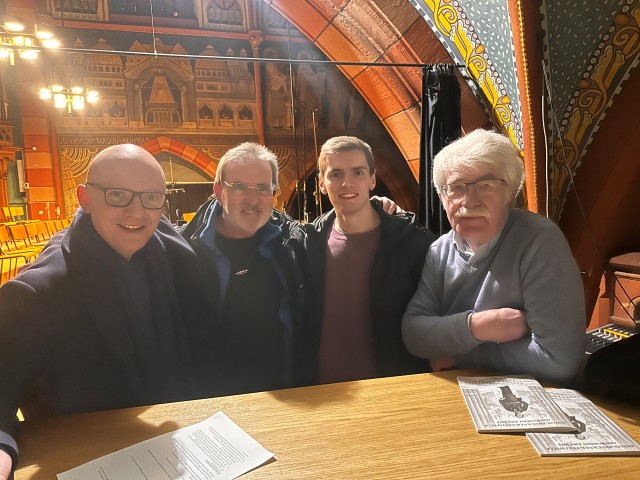
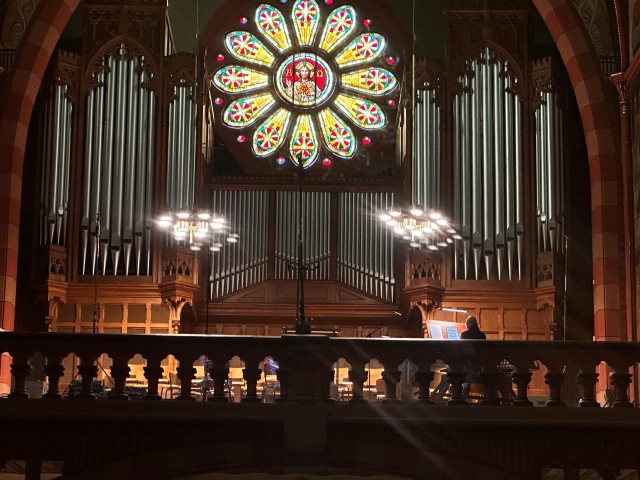
St Martin’s Church at Dudelange came to our attention and in contrast to some locations, their enthusiasm to host this project was considerable and the speed of correspondence between parties was second to none. The booking was made for late January 2025 with Joseph arriving about a week in advance from Australia where he now lives.
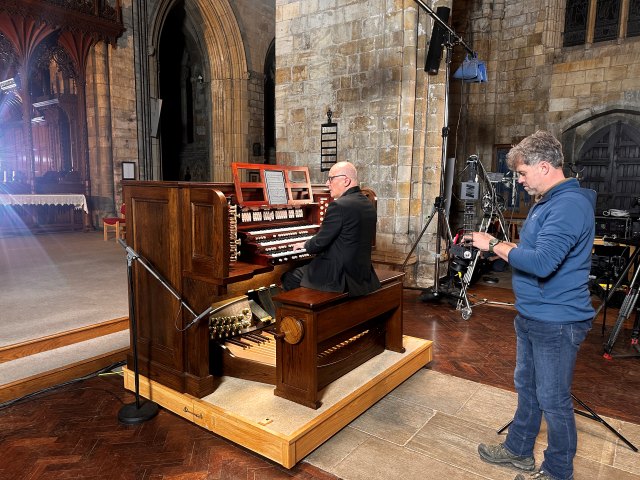
This allowed time to settle into a very different time zone and to visit Selby Abbey, where he would make some recordings on our instrument that a few weeks later would be in St John’s College Cambridge to cover the rebuild of their pipe organ.
We planned to make a recording of one of the Alkan pieces and the spectacular variations that last 15 minutes on the well known hymn Ein Feste Burg was chosen. I believe this is the only video version of the piece to be published. When you listen to the recording, I am sure you will share my thoughts that this has to be a pinnacle of composition.
The foundation on the opening two phrases of the hymn feature time and time again throughout the piece, but dressed in a multitude of rhythmic and harmonic disguises that range from circus like barrel organ music to much more formal and dignified interpretations. The successful combination of these far-ranging extremes is a giant of skills. I wonder what Alkan must have been drinking or smoking to create this extraordinary piece to such perfection.
Charles-Valentin Alkan – a remarkable child prodigy
Charles-Valentin Alkan was born in Paris on November 30, 1813. The family was notably musical – all of Alkan’s siblings pursued successful careers in music, including roles as professors, composers, performers, and publishers.
Alkan was a remarkable child prodigy who entered the Paris Conservatoire at age 5, where he excelled in both piano and organ studies. Under the tutelage of Joseph Zimmerman, he won numerous prizes and began performing publicly at age seven. By his teens, he was performing in prestigious Parisian salons and was appointed as a professor of solfège at age 15. That’s Do, Re Mi. I had to look it up!
During the 1830s, he established himself in Parisian artistic circles, becoming friends with notable figures like Liszt, Chopin, and George Sand, while developing his career as both a performer and composer. There is an Alkan Society dedicated to the memory and work of this remarkable person.
Reviews hit all the heights of praise for Joseph
Volume 1 of the 3 CD’s produced by Signum were released about 6 months ago and the publishing of this blog had to be delayed until the musical world had time to react. Volume 2 is now out with 3 expected early next year. These are compelling acquisitions for all organists. The reviews have hit all the heights of praise for Joseph and indeed the St Martin’s organ.
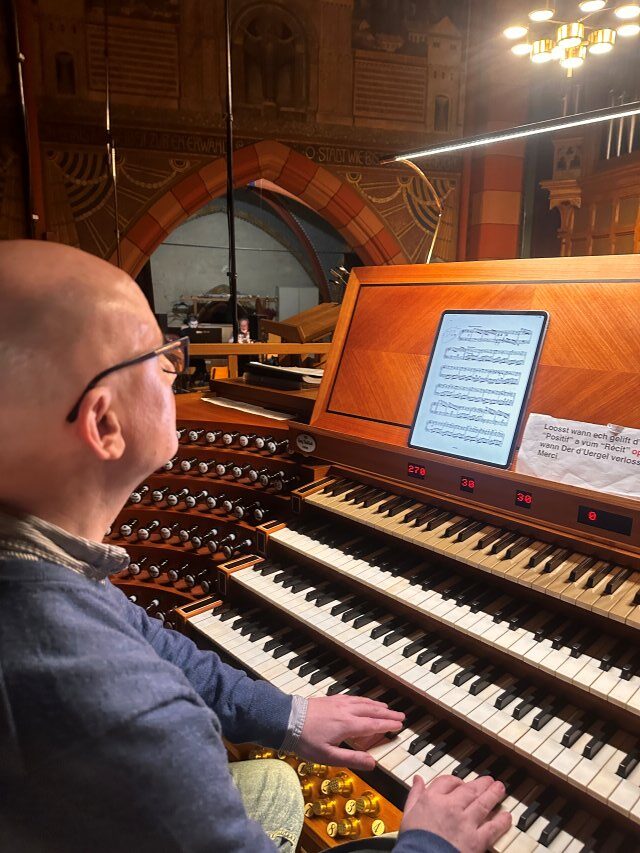
I am delighted that we have the opportunity not only to let you hear Joseph playing one of the worlds most magnificent organ pieces but also see him at the console demonstrating musicianship of the very highest order. It is an honour to work with a man who makes the most complex and technically demanding music look like an afternoon walk in the park. The page turner, actually in this case the iPad prodder, was far from relaxed by the challenge.
Obviously as a friend of Joseph’s, you may feel my views carry a little bias but below are some of the independent critics comments about the recordings that speak the highest level of praise possible on what will likely remain the hardest 4 night organ marathon ever to be undertaken.
“This is genuinely the most thrillingly realistic organ sound I think I have ever encountered on a commercial recording” Designated recording of the month too.
MusicWeb International
“The fugue’s closing pages, in Nolan’s hands, arrive with the force of something long suppressed finally breaking free – exhilarating, unsettling, and wholly unforgettable.”
Will Yeoman
100% – “Nolan is an organist with a mind of his own and this record is in a class of its own … Nothing else like it on record.”
Norman Lebrecht / Slipped Disc
“Joseph Nolan, who has recorded Alkan’s complete organ works, is convinced of his genius, comparing the music to “Widor on steroids”. Listening to this first volume, performed on the breathtaking organ of Église Saint Martin in Dudelange, Luxembourg, that seems an apt description. Not only does Nolan’s playing exhibit a death-defying virtuosity, Signum’s richly spacious recording is guaranteed to put the swankiest of speaker systems through its paces.
Much of this first volume is given over to the kaleidoscopic 11 Grands Préludes and one transcription of Handel’s Messiah. These are extraordinary – and extraordinarily complex – works, full of harmonic ticks and quirks and seething with quasi-orchestral colour. Nolan’s imaginative choices of palette here are exhilarating, his thunderous instrument roaring with an operatic frenzy one minute before dropping to a pianissimo whisper the next. Try the fourth prelude with its perky marching tune, or the sublimity of the Brucknerian ninth, or the bacchanalian 10th, which exudes a heady whiff of the exotic.
The recital ends with Alkan’s majestic Impromptu on Luther’s A Mighty Fortress Is Our God. It’s a true Everest of the organ repertoire and given a towering workout by the indefatigable Nolan”
***** The Guardian Newspaper
Enjoy the recording of this magnificent piece of music
Ein Feste Burg ist unser Gott (A might Fortress is our God) was a hymn both written and composed by Martin Luther in the late 1520’s. He wrote about 40 other hymns but this is undoubtedly the most well known that remains in regular use to this very day. The robust tune will be very familiar to organists and church attendees. The translation of the first verse below is somewhat rambling. But remember its in a context of 500 years past.
God’s word, for all their craft and force,
one moment will not linger,
but, spite of hell, shall have its course;
’tis written by his finger.
And though they take our life,
goods, honour, children, wife,
yet is their profit small;
these things shall vanish all:
the city of God remaineth.
The opening two phrases are initially presented solely by a pedal line. It could have been written in the last hundred years showing little personality of the medieval period when it was first set down. Alkan quickly gets to work adding layers of development and words fail me to explain what then follows. You just have to watch and make your own mind up.
I hope you will enjoy the recording and share my huge sense of enjoyment in bringing this magnificent piece and performance to your attention.

I have had a passion for church organs since the tender age of 12. I own and run Regent Classic Organs with a close attention to the detail that musicians appreciate; and a clear understanding of the benefits of digital technology and keeping to the traditional and emotional elements of organ playing.

